



Unusual optimism in the US financial sector; Analysts' expectations

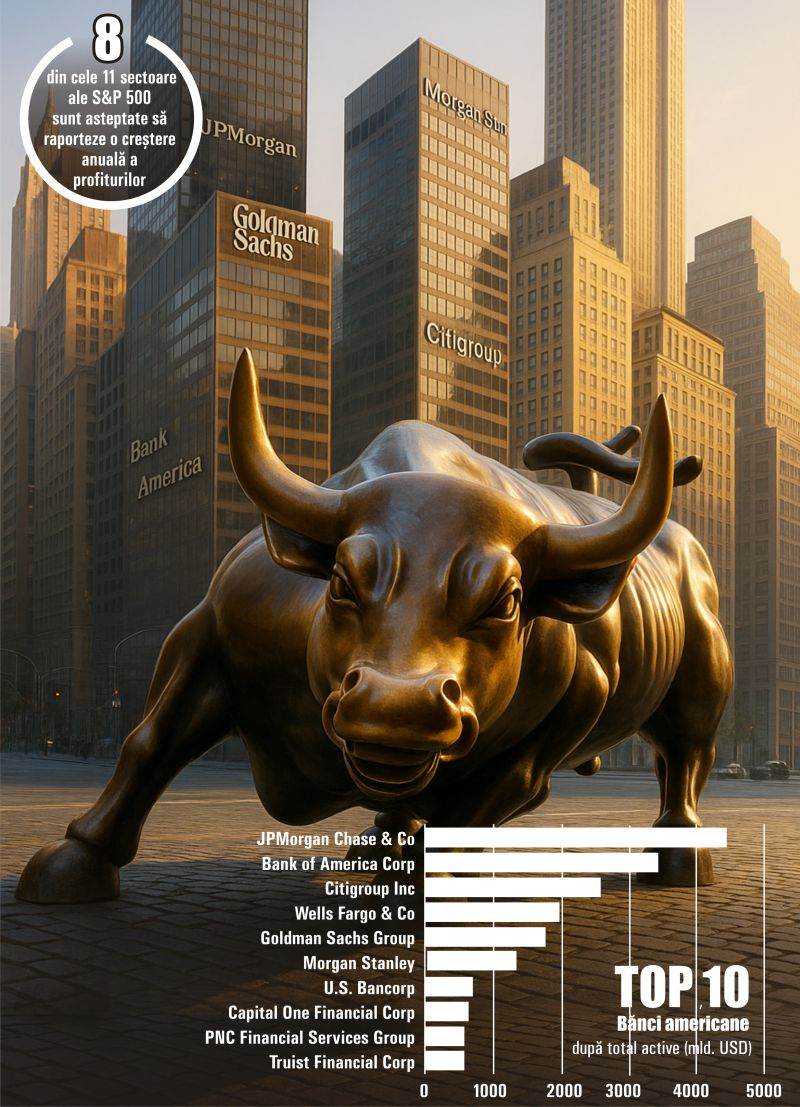
High market volatility, driven by tensions surrounding trade tariffs in the first half of 2025 and the rebound in stock indices since April, supported solid first-half performances by major US banks. The third-quarter earnings season is about to begin with an unusual level of optimism, with the financial sector topping growth estimates, amid a supportive monetary policy and regulatory framework, according to a report by the Research Department of the Federal Reserve Bank of New York. TradeVilleThe report presents the main analysts' estimates for six of the largest American banks, JPMorgan Chase & Co, Morgan Stanley, The Goldman Sachs Group Inc., Bank of America Corp., Citigroup Inc. and Wells Fargo & Co, the evolution on charts in relation to the US Stock Exchange, as well as several possible scenarios in the coming period.
• iShares S&P US Banks UCITS ETF – 17% return in the last 12 months
iShares S&P US Banks UCITS is an ETF that tracks the performance of the S&P 900 Banks 7/4 Capped index, representing the US banking sector. The ETF was launched on May 21, 2018, has assets under management of €552 million and reinvests dividends. The ETF's portfolio is made up of 99% in US bank stocks, including a total of 42 financial institutions. The ten largest holdings represent 55.4% of the portfolio, and four of the six banks analyzed in this report (JPMorgan, Morgan Stanley, Goldman Sachs, Bank of America, Citigroup and Wells Fargo), hold a cumulative weight of approximately 28.55%. Over the past 12 months, the ETF has generated a return of 17%, and since the beginning of the year, of 0.33%.
• The American banking sector, between tariff and monetary policy
The financial and banking sector plays an essential role in a country's economy, with lending being the engine of economic growth. In 2025, net interest income in the global banking market is estimated to reach $8.9 trillion, and, according to Statista, net interest income will register a compound annual growth rate (CAGR) of 4.911% through 2029.
As for the US financial sector, it recorded a growth of 30% in 2024, exceeding the performance of the S&P 500 index (+23%), being the third best performing sector after the communications and technology sector. In the first nine months of this year, the growth recorded by the financial sector is 13%, slightly below the S&P 500 growth of 14.85%. On June 30, 2025, the 50 largest banks in the US had cumulative assets worth 25.176 trillion dollars, according to S&P Global Market Intelligence data. The evolution of companies in the sector was influenced, in 2024, on the one hand, by the solid financial results reported, but also by the monetary policy decisions of the Federal Reserve (Fed), and the presidential elections, the financial sector being one of the areas favored by Donald Trump's election victory. The Fed's maintenance of interest rates in the first nine months of 2025, the solid results reported, but also the tensions generated by the imposition of trade tariffs by the Trump administration, and geopolitical factors influenced the evolution of companies in the financial sector this year.
The stress tests, conducted at the end of June 2025 by the Federal Reserve, brought better results compared to those in 2024. The Fed introduced the Dodd-Frank stress tests to assess whether the largest American banks can withstand a severe economic crisis, with the aim of preventing a repeat of the 2008 financial crisis. American banks successfully passed the tests, being well positioned to continue with payments to shareholders, including dividends and share buybacks.
After a nine-month hiatus, the Federal Reserve cut interest rates by 25 basis points at its September 17 policy meeting, setting a target range of 41.5% to 4.25%, in line with consensus expectations. Although the dot plot suggests the Fed is likely to make two more 25-basis-point cuts this year, Jerome Powell, the head of the US central bank, said the Fed faces a “challenging situation” given high inflation and weak labor market conditions and will make decisions “on a meeting-by-meeting basis.” Powell described the cut as a “risk management” move in response to downside risks to the labor market. However, the government shutdown, which began on October 1, is depriving the Federal Reserve of key monthly employment data, just when such information is essential to its decisions. In their absence, policymakers and investors have turned to other proxy indicators – including the job openings report (JOLTs), the ADP private sector hiring report and weekly state jobless claims data – to get a feel for the market.
The government shutdown and lack of data did not prevent markets from anticipating two more Fed rate cuts, each of a quarter of a percentage point, this year.
According to FedWatch CME, the chances of a 25 basis point cut in the benchmark interest rate in the October and December meetings are 92.5% and 79.9%, respectively. A reduction in the benchmark interest rate level can encourage consumption and stimulate lending, positively influencing the profitability of companies in the sector, it notes. TradeVille.
• Analysts' estimates
Eight of the 11 S&P 500 sectors are expected to report annual earnings growth, led by information technology (IT), financials, utilities and materials. The S&P 500 is expected to report annual earnings growth of 81.5%, up from 7.31% expected at the start of the quarter. If achieved, it would mark the ninth consecutive quarter of earnings growth for the index, cementing its recovery from the 2022 correction.
JPMorgan kicks off the banking reporting season on October 14, along with Citigroup, Goldman Sachs and Wells Fargo & Co. The biggest revenue increases are expected by analysts for Morgan Stanley, 14.86%, and Goldman Sachs, 9.85%. In terms of earnings per share (EPS) growth, Goldman Sachs and Bank of America lead the way, with expectations of 28% and 14.63%, respectively. At the opposite end of the spectrum is Citigroup, for which analysts' estimates are more modest: an average increase of 4% in revenue and 5.88% in EPS.
• Share price developments
Year-to-date (YTD), the performance of the companies analyzed in this report has ranged from +141% (Bank of America) to +40% (Citigroup). During this period, US indices have gained 14.4% (S&P 500) and 181% (Nasdaq Composite).
Citigroup (C) shares occupy the top position, with a YTD increase of 40%, three times higher than the S&P 500 index. After a strong upward trend that began in December 2023, the C share price retested the resistance in the $80-84 area several times during 2024, a level below which it traded for the last 16 years, with the historical high being $570 (in December 2006). In July 2025, amid the reporting of financial results above analysts' expectations and increasing estimates for the end of this year, the share price broke through this resistance level, increasing to $98. The exit from the ascending triangle formation created between July and September led the C share price to a 17-year high of $105.59.
The second position in the top YTD growth is occupied by Goldman Sachs (GS) shares, with an appreciation of 38.58%, the annual performance (YOY) being the highest in the group, of +61%. After a sideways evolution during 2023, in April 2024 the price managed to exceed the historical high of November 2021, of 426 dollars, the GS quotation entering an upward trend throughout 2024, until recording a new historical high in February 2025, of 672 dollars. The positive evolution was supported by both the solid financial results reported, as well as the monetary policy decisions of the Federal Reserve, and the presidential elections, the financial sector being one of the areas favored by Donald Trump's election victory. Between February and April 2025, the GS price recorded a significant decrease of 30%, in the context of market corrections amid tensions generated by trade tariffs, but recovered the entire decrease and reached a new historical high of $825 in September 2025. The historical high area represents an important level of resistance in the coming period, while support is found around $750.
Shares of the largest bank by market capitalization, JPMorgan (JPM), have registered a 28% increase since the beginning of this year. The evolution of JPM shares is similar to that of GS, a strong upward trend throughout 2024, a peak reached in February 2025, followed by a correction of over 30% and a V-shaped return with a historic high in September, of $318. The $300 area represents an important support area, with resistance at the historic high.
Along with GS and JPM, Wells Fargo & Co. (WFC) shares also hit an all-time high of $86.66 in September, marking a 161.5% gain since the beginning of the year. WFC is currently trading at $82, with the all-time high representing a significant resistance level, while initial support is found in the $80-81 range.
After an upward trend that began in October 2023, Morgan Stanley (MS) shares managed to exceed the historical high of $109 (reached in January 2022) in October 2024, and following the rally determined by the results of the presidential elections, they recorded a new historical high in February, of $142. After the 34% decrease suffered between February and April 2025, the MS share price recovered the loss suffered and recorded, like the other companies in the group, a historical high in September 2025 ($163.98).
Bank of America (BAC) shares are at the bottom of the list in terms of both YTD performance, +13.55%, and YOY performance, +26%. After a v-shaped recovery in the first part of this year, BAC's share price managed to surpass its December 2024 high, rising to $52.88 in September 2025, but it is still trading below its January 2006 all-time high of $55.
• Options and target prices
To determine how the market will react to the new banking sector reports, we will analyze in this section the option prices for the six companies, taking into account the prices of options expiring on October 17 for JPMorgan, Bank of America, Wells Fargo, Goldman Sachs, Citigroup and Morgan Stanley. The price movements that the market expects for the six banks are between +/-2.05% (BAC) and +/-2.56% (C). The group average for the market movements after the report is +/-2.26%.
Regarding the rating, according to the specialized website Wall Street Journal, all six companies analyzed have an "Overweight" consensus from analysts.
In terms of target price, the greatest growth potential, according to WSJ analysts, is for Citigroup shares (+14.2%), followed by Bank of America shares, with 12.2%. On the other hand, Goldman Sachs shares have greater negative potential, at 2.51%.
Source: https://www.bursa.ro/