



Rating of the world's most stable economies in 2025

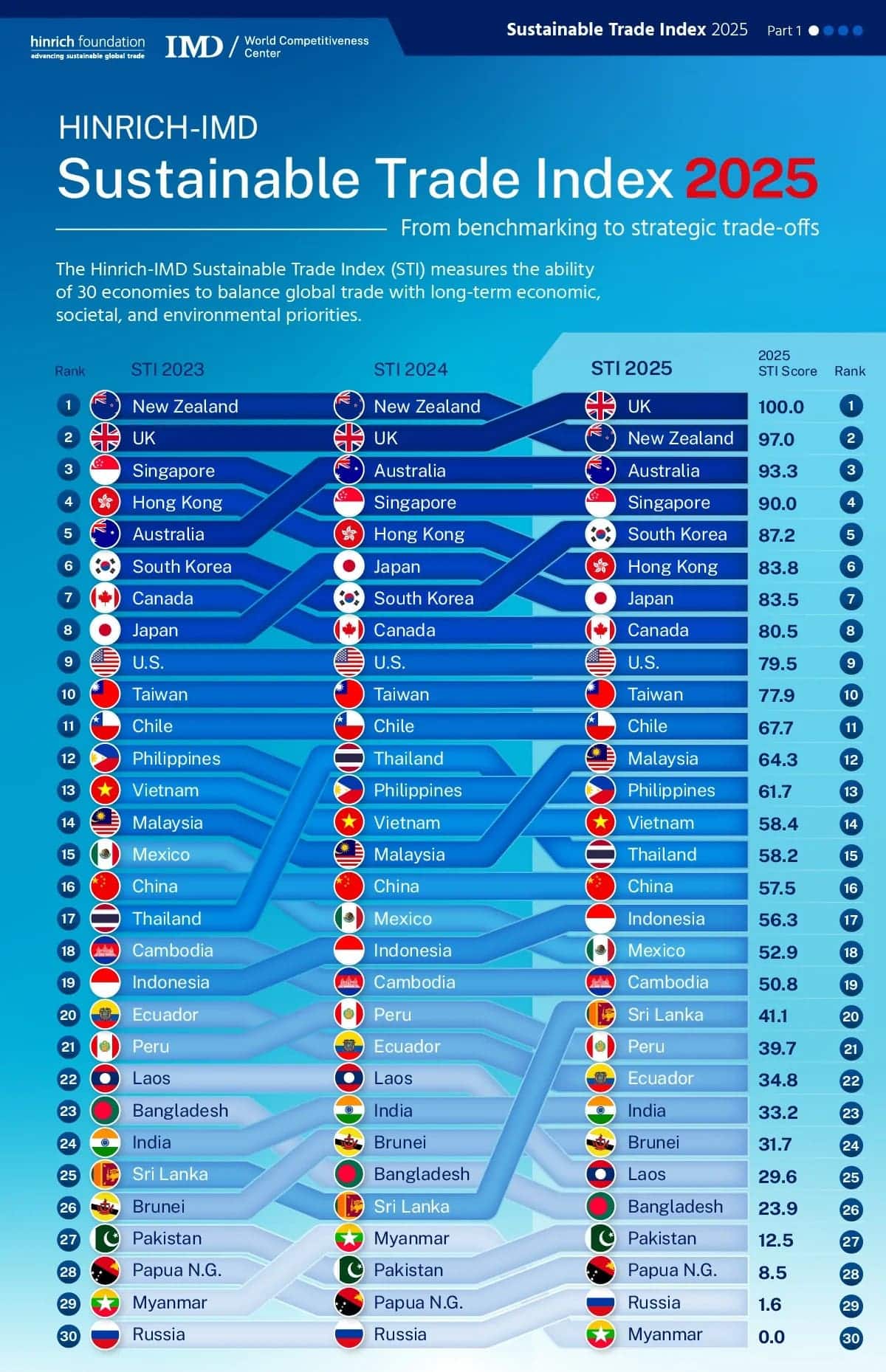
The Hinrich Foundation Foundation presented the updated Sustainable Trade Index (STI) — the annual rating of the 30 leading economies of the world, prepared in conjunction with the IMD World Competitiveness Center. The index estimates how stable the country is in trade, combining economic development, social stability and environmental responsibility.
The main goal of the rating is to help governments, researchers and experts understand the relationship between global trade and the sustainability of economic systems, as well as stimulate the discussion about the long-term sustainability of the world economy.
In 2025, Great Britain took the first place, rising from last year's second position and moving New Zealand to the second place. Australia and Singapore kept their positions — №3 and №4 respectively.
Some countries demonstrated noticeable growth:
- South Korea rose from 7th to 5th place,
- Malaysia — с 15-го на 12-е,
- Sri Lanka made one of the most impressive jumps — from 26th to 20th place.
Others, on the contrary, lost positions:
- Thailand dropped from 12th to 15th place,
- Laos — с 22-го на 25-е,
- Myanmar, which is in a state of internal conflict, fell from 27th to 30th place, replacing Russia on the last line (Russia occupied this place in 2023 and 2024).
The STI index is based on three key directions, within which 72 indicators are evaluated:
- Economic stability — competitiveness, trade openness, innovations;
- Social stability — уровень образование, зашитать правы работы;
- Ecological sustainability — energoeffektivnost, emissions, ecological policy.
It is interesting that GDP per capita correlates noticeably with economic and social pillars, but is almost unrelated to environmental indicators.
Thus, countries with high income — Great Britain, New Zealand and Australia — showed high results in the environmental direction. At the same time, Canada, South Korea and the United States, despite their high GDP, are inferior in terms of environmental performance
Source: naked-science.ru/